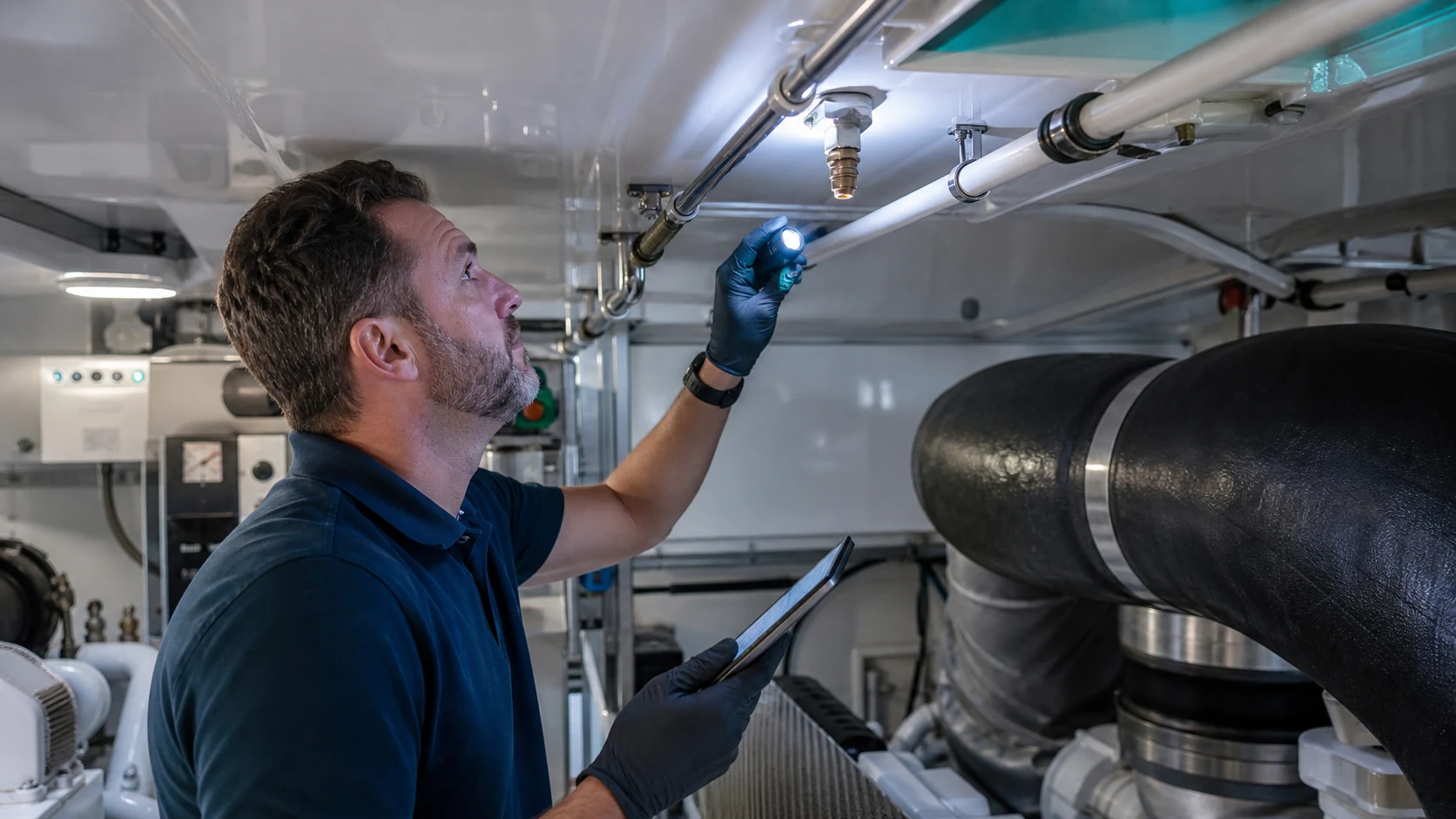
Machinery-Space Fire Protection Inspections in Palm Beach County
Marine Fire Protection Palm Beach accepts inspection requests for fire systems protecting nonstandard vessel machinery spaces throughout Palm Beach County. This service covers enclosed propulsion, mechanical or fuel-related compartments that do not fit a conventional engine-room or dedicated generator-room description. Vessel layout and installed equipment determine whether this focused service is appropriate. Provide photographs and a clear description of the enclosure, or call for a vessel-specific evaluation.
Fire-Equipment Inspections for Nonstandard Palm Beach County Machinery Spaces
Some vessels contain machinery enclosures that differ from a walk-in engine room. Inspection may address the accessible cylinder, control arrangement, manual release, visible discharge components, service information and boundaries of the space served by the system. The compartment should be described by function and contents instead of being assigned an inaccurate label.
- Inspection may address the accessible cylinder and its visible condition within the presented machinery-space fire suppression system.
- The control arrangement and manual release may be reviewed with visible discharge components and theprotected enclosureserved by the system.
- Visible discharge components may be considered alongside the boundaries of the space served by the system.
- The compartment’s access and the presented manual release arrangement help define the inspection scope.
- Ventilation or shutdown interfaces may be noted where they are visibly associated with the presented system.
- The inspection remains focused on marine fire equipment and does not become a mechanical, electrical or complete vessel survey.
- Available service information and records can help keep the inspection specific to the equipment and compartment presented.
Propulsion machinery, auxiliary equipment and fuel-related components can create different fire-equipment contexts. A clear description of the enclosure helps identify whether machinery-space fire protection inspection is appropriate and prevents separate enclosures from being treated as one protected space.
For a vessel-specific evaluation, provide photographs and a clear description of the enclosure.
Request an InspectionDescribe the Compartment by Function
Use the Brief Description field to explain what equipment occupies the enclosure and how the space is accessed. Identify its purpose without assuming a specific system design. Include images of the compartment, cylinder, controls and discharge components.
Compartment Purpose
Describe whether the enclosure contains propulsion, auxiliary, fuel-related or other mechanical equipment.
Access Conditions
Explain how the space is accessed and identify any safe-access limits before scheduling.
Visible Equipment
Include images of the compartment, cylinder, controls and visible discharge components.
System-Specific Details
Identify the purpose of the enclosure without assuming a specific fire suppression system design.
Describe the compartment by function and contents rather than assigning an inaccurate label.
If the enclosure or equipment has changed, provide current photographs and a clear description for evaluation.
Review protected-space componentsIdentify Independent Fire Systems
A vessel may use one fire suppression system for its principal engine room and another for a remote machinery compartment. Each cylinder, control and protected enclosure should be listed independently. Service records should remain system-specific, and one inspection date or condition should not be transferred automatically to another compartment.
Separate Compartments
List each machinery enclosure independently when more than one compartment is present.
Separate Controls
Identify the cylinder, control and protected enclosure associated with each individual system.
Clear Equipment Map
Photographs of the compartment, controls and discharge components help distinguish separate protected spaces.
System-Specific Records
Keep available service records with the system and compartment to which they apply.
Request Machinery-Space Inspection in Palm Beach County
Provide the vessel type, approximate length, physical location, compartment use, system manufacturer and reason for inspection. Include available records or the exact wording of a reported deficiency. Inspection may support routine planning, a survey response, insurance documentation or evaluation of a visible concern.
Vessel Information
Include the vessel type, approximate length and physical location when requesting machinery-space fire protection inspection.
Request service →Compartment Use
Explain the machinery-space function, its contents and how the enclosure is accessed.
Request service →System Details
Provide the system manufacturer, available records and photographs of the cylinder, controls and discharge components.
Request service →Survey or Insurance Deficiency
Include the exact wording of a reported deficiency so the requested inspection scope can be evaluated.
Request service →Safe Access
If safe access is limited, explain the constraint before scheduling. Do not remove panels, activate controls or disturb equipment merely to prepare for the request.
Request service →Boatyard Conditions
Some machinery enclosures are easier to reach while a vessel is ashore or undergoing other work. Identify the vessel’s status and facility contact so access can be evaluated. Customers remain responsible for permission, safe entry and coordination with other onboard work.
Request service →Machinery-Space Fire Inspection FAQs
Machinery-space fire protection inspection may support routine planning, a survey response, insurance documentation or evaluation of a visible concern. It does not provide system-design approval or guarantee acceptance by another party.
Request a Machinery-Space Inspection
Send the vessel type, approximate length, physical location, compartment use, system manufacturer and reason for inspection. Include photographs, available records and the exact wording of any reported deficiency. For help defining the scope, call Marine Fire Protection Palm Beach.